Loose Pass: British & Irish Lions ‘vastly underestimated’ next-gen Pumas while Springboks retain ‘competitive advantage’

This week we will mostly be concerning ourselves with the British and Irish Lions’ opener, diversity and Argentina’s continued development…
Controlling expectations
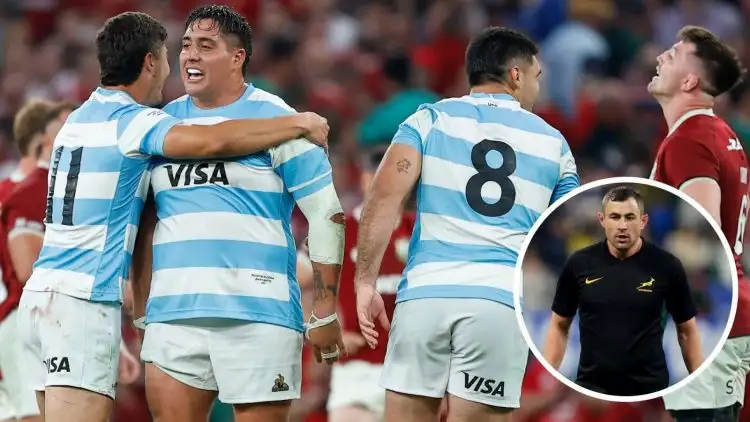
What to make of the Lions‘ opener? Certainly, an alternative version had already been played out in many internal Dreamlands in the days leading up to the match. That included bookies, whose 7-1 estimation of Argentina‘s chances vastly underestimated the talent of a team which can rightly look forward with excitement to the rest of this World Cup cycle.
More on that shortly. In the meantime the match illustrated the difficulty of lifting players out of the travails of a ludicrously long season and giving them an entire raft of new calls and structures to learn, practice and get spot on at first drop. The attacking shapes looked promising and brimming with options, even if the timing was off and the energy levels looked a little low. The difference between ambition and execution was clear. Scrums went well, but the line-out timing and accuracy was all over the place. The occasional lack of urgency and domination at rucks was reflective of a bunch of players trying to find their roles and rhythm with each other. All of this with the spectre of a dream-shattering injury looming large over it all. It’s hardly a situation designed for team success, even if individuals – such as Ellis Genge – seized the chance to shine.
And players had a different mindset in terms of their own performance. This was not just a potential Test team finding its mojo in the knowledge that selection for the future matches may not rest on one error or moment of excellence, this was a collection of individuals auditioning for the highest individual honour available in the game: a Lions Test cap. Some of the auditions were made together with the direct competition for the same role. Most of the players likely only have two more chances to audition for that, and neither of those will be against the same calibre of opposition. Decisions were made that might not have been made in a Test team. Errors under pressure were squeezed out.
So no, it wasn’t perfect. Nor was the atmosphere on a muggy night in Dublin; it also represented the feel of an audition more than the real performance, while the local bias in the cheers for individual players, although understandable, thoroughly undermined quite a lot of what the Lions is about; it didn’t feel like a Lions tour fixture.
But it was never going to be perfect. It’s another fixture shoe-horned into the overstuffed calendar, a tour that started prematurely and without one-third of its tourists. It felt rushed and jittery, it was always going to. The tourists will reveal a lot more about their direction this coming weekend in Perth.
Selection policies
One of the most revelatory soundbites this week came from Felix Jones, who reflected on how South Africa‘s decision to select the best players always, regardless of where they play their sub-international rugby, has created a diversity within the squad that enables them to deepen input on almost any challenge.
It’s hard to not perceive, in an age where players such as Joe Marchant and Jack Willis are excluded from England selection because they play in France, or where talents such as Joe Hawkins disappear – temporarily at least – from Welsh rugby because of a decision to make a living down the M5 in Exeter, or where New Zealand regularly loses a significant chunk of playing stock at the ‘just underneath All Black’ level, that this is a significant competitive advantage for the Boks in terms of streetwisdom and experience.
So Joe Schmidt’s decision to relax his stance on calling in a couple of overseas players feels significant in this, the start of five generational years for Australian rugby that feature this Lions tour, the World Cup for men in 2027 and the same for the women in 2029. Will Skelton will bring oodles of nous as well as 130-odd kilos and memories of once having played against the Lions (for the Waratahs back in 2013). Nick Champion de Crespigny’s name-making season in France might also add something new and different to the mix.
Meanwhile, Jones’ soundbite gave the impression that he simply enjoyed the diversity more than the somewhat narrower English Premiership-only environment. Will it give food for thought to those nations who prefer to remain insular?
Albornoz the poster boy for a new Argentinean generation
Argentina has always relied on players who have plied their trade abroad, but the emergence of a number of talents from the Jaguares and, more recently, the Dogos, Tarucas and Pampas teams, shows just how well the Argentine structure at home is working too.
It’s not just the emergences of talents such as Tomas Albornoz – who, at 27, is older than many perceive – or scrum-half Gonzalo Garcia, it’s the youngsters charging into the engine room, such as number eight Joaquin Oviedo or lock Pedro Rubiolo (both talents honed in the Jaguares) who are ensuring Argentina continue to do more than making up the numbers.
The talents do leave. All four of the above are, respectively, based in Italy, France and England now. But the cover of Argentinean talents at top European teams has grown and grown, built on those solid domestic foundations. A new generation of Pumas is here and it looks at least as good as the previous ones.