Law discussion: Leinster’s controversial non-try v Northampton was the correct decision, here’s why

Law discussion: Was Leinster’s disallowed try v Northampton the correct decision?
Following a gripping Investec Champions Cup semi-final between Leinster and Northampton Saints, we take a look at a pivotal officiating decision that played a huge role in the outcome of the match.
Northampton booked their place in the finale in Cardiff on May 24 courtesy of a 34-37 victory over the far more fancied Irish outfit.
However, it was far from plain sailing as the Premiership club and their fans held their breath in the final knockings of the match as French referee Pierre Brousset requested a review from his TMO Tual Trainini.
Controversial call
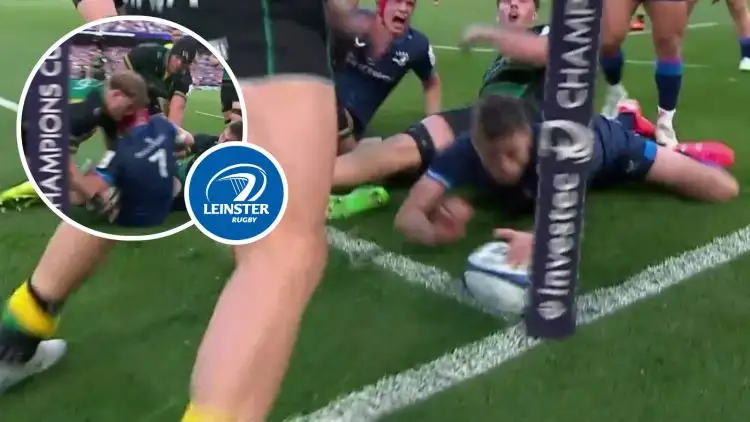
The incident in question is of course Ross Byrne’s disallowed try as the clock ticked into the final minute of the match.
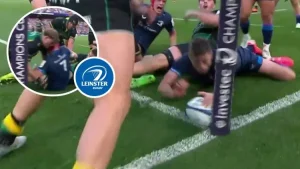
At the time Leinster were trailing by three points and had turned down the opportunity to level the scores and went for the jugular.
Saints forwards Henry Pollock and Alex Coles pilfered over a turnover, stopping Leinster’s attack dead in its tracks with Tom James’ clearance pushing the Irish province back to a lineout just beyond Northampton’s 10-metre line.
Leinster then launched a multi-phase attack which eventually led to Jamison Gibson-Park switching the attack to the short side with James Lowe setting Josh van der Flier charging down the touchline.
The flanker barges into Tommy Freeman, who just about holds on, with Coles charging in and dislodging the ball from the Irish flanker’s grasp.
In the chaos, James attempts to avoid the ball as he runs back onside, but as he turns around, Byrne has stretched out to dot the ball down on the corner flag for what looks to be a try to put Leinster back in front in the dying minutes of the game.
Brousset now blasts his whistle with players from both teams already pleading their case to the referee amid the euphoria of the Aviva Stadium cheers.
What would follow was arguably the biggest decision of Brousset’s career to date as he decided whether Leinster had scored or not. Ultimately, he went with the latter but issued a yellow card to Saints forward Coles for his actions. But was he right in his decision-making? Let’s unpack the complex call.
Tight calls
For starters, Brousset’s on-field decision is no try, meaning that clear and obvious evidence is needed to overturn the referee’s decision. However, the referee wanted to check whether Coles had ripped the ball from Van der Flier on the ground. Adding, “Then we will look if there is a grounding from blue or if the ball is in touch.”
His suspicions about how the ball popped out of Van der Flier’s grasp proved to be correct as Coles clearly rips the ball while on the ground.
Law 14.5 states: “Tacklers must…”c. Be on their feet before attempting to play the ball.”
Alex Coles rips the ball from Josh van der Flier
It’s the type of action that the referee may well ignore if it occurred in the middle of the pitch but considering the fact that Leinster are so close to the line and the events that unfold afterwards, Brousset has no choice but to take into consideration – and understandably so.
So once the officiating team had decided that Coles had conceded a penalty, it was a straightforward call that he should be yellow carded for the professional and cynical penalty so close to the try line.
Byrne’s actions
But there it comes to whether Byrne had scored the try or not…
Before the ball spills out, Byrne is tearing towards the breakdown. He joins the mess and actually goes off his feet before reaching out and applying downward pressure on the ball that is touching the corner flag padding.
The easy rule is always “off your feet, out of the game” but more specifically, law 13.3 states, “A player on the ground in the field of play, without the ball is out of the game and must:
a. Allow opponents who are not on the ground to play or gain possession of the ball.
b. Not play the ball.
c. Not tackle or attempt to tackle an opponent.
Byrne fails to do a or b, meaning that it would have been a penalty to Northampton Saints had Coles not dislodged the ball illegally.
Had the replacement fly-half been deemed to be on his feet, then the try would have still been disallowed because of where he had dotted it down.
This is explained by Law 21.15: “If the ball or ball-carrier touches a corner flag or corner flag post without otherwise being in touch or touch-in-goal, play continues unless the ball is grounded against the post.”
Leinster’s Ross Byrne’s disallowed try in the Champions Cup semi-final.
There is also a case to be made that Byrne was also in front of the last man’s feet at the tackle. One could claim that the ball came out and touched another player’s leg who wasn’t part of the tackle and therefore he is onside but that isn’t clear and obvious. However, it is clear and obvious that he is off his feet, he is out of the game, and can’t score the try.
Ultimately, the officials decided to penalise the cynical infringement from Coles with Brousset deeming that a penalty try was not warranted as Van der Flier was dragged down short and couldn’t reach out to score. A penalty try is only awarded when foul play prevents a probable try from being scored but there was enough doubt about a possible try being scored to not sanction Saints in that manner.
Additionally, he explains that the ball touched the base of the corner flag, which can’t be used in the act of scoring as explained above.
The officiating team came to the correct decision, in our opinion, and one has to commend them for doing so in such a pivotal moment of a decisive match. There were several incidents that could be used to disallow the try but the one they pinpointed was certainly the easiest to explain and with Leinster getting a penalty anyway, it mattered little.
World Rugby also encourage TMO decisions to be discussed and decided in English to ensure clarity for the viewers but in this case, it was positive that Brousset and Trainini defaulted to their mother tongue to ensure accuracy in the decision-making. Equally so, the referee then explained the decision in English to the two captains and the fans in attendance.
Planet Rugby reached out to a current elite professional match official to ensure that the technicalities and law interpretations expressed in this article were accurate and fair – which they did.